
Guide
Wind turbines for homes
What a home-scale wind turbine can realistically do, and how the wooden Carnetic 316 vertical axis turbine is built for houses, farms and smallholdings.
Why a vertical axis turbine suits a house
It fits a normal plot
A vertical axis turbine takes wind from any direction, so it needs no tail, no yaw mechanism and no wide clearance circle for a long horizontal blade. The H-rotor sits on a single 6 metre tower and occupies roughly the footprint of a garden shed.
It runs day and night
Solar panels stop at sunset and slow down in winter. Wind is strongest exactly when a house needs the most energy — cold, dark, windy months — which is why wind and solar complement each other so well on the same property.
Wood is quiet and low-impact
The wings are laminated cedar rather than glass fibre. Wood damps vibration instead of ringing with it, stores CO2 rather than releasing it, and can be repaired at home with ordinary woodworking tools.
You can build it yourself
The full design package for the Carnetic 316 is published free under a Creative Commons BY 4.0 licence. Build one, adapt it, or have a local workshop make the parts — you only have to credit Carnetic.
Four steps before you order anything
- 01
Check your wind, not your roof
Average wind speed at hub height decides everything. Open farmland, coastline and exposed hillsides suit a home turbine; a sheltered suburban garden between tall buildings usually does not. Roof mounting is not recommended — vibration travels into the house.
- 02
Check the rules before the hardware
Most countries treat a 6 metre mast as a planning matter. Ask your municipality about height limits and distance to boundaries, and ask your grid operator what is needed to connect or to run the turbine off-grid with batteries.
- 03
Decide: build or buy
Download the free drawings and build from them, order individual parts such as wings, hub, bearing or tower from the shop, or take the complete turbine as one package.
- 04
Plan the foundation and the electrics
The tower needs a concrete foundation sized for your ground conditions, plus a cable run, a controller and either a grid inverter or a battery bank.
What it produces, honestly
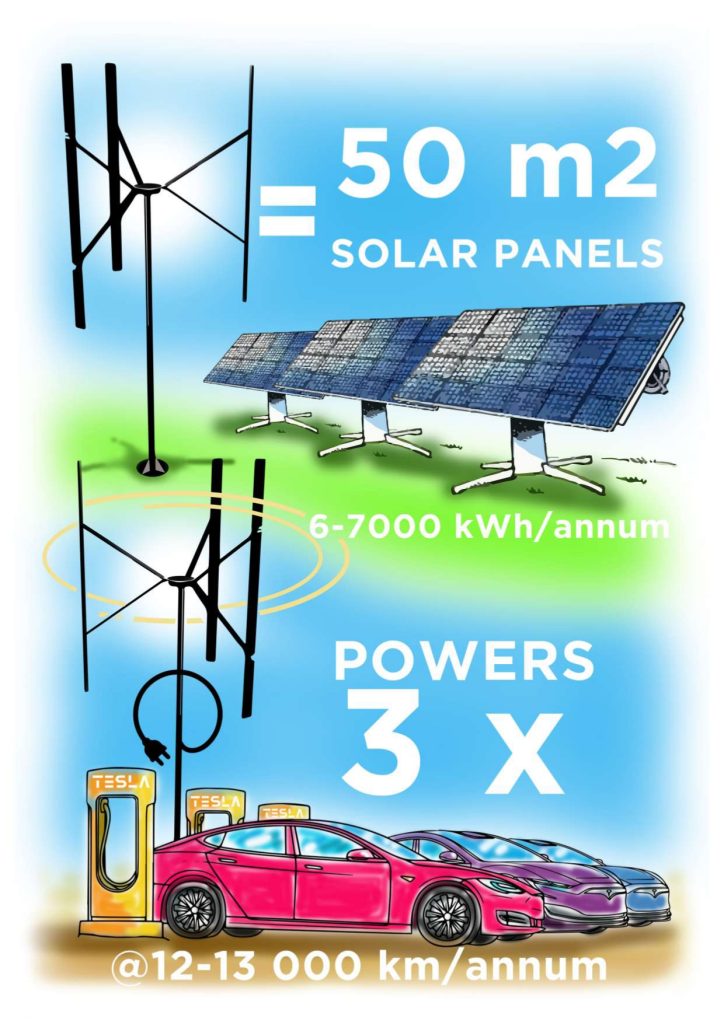
The Carnetic 316 is rated at 3 kW in a 9 m/s wind with a 16 m² intercepted area. Real annual output depends entirely on your site: a windy, open location can pass 10,000 kWh a year, while a sheltered one will produce a fraction of that. Nobody can quote your yield without knowing your average wind speed, so treat any single number — including ours — as a starting point for your own calculation.
Not sure if your site is windy enough?
Tell us where you are and what you want to power, and we will tell you honestly whether a home turbine is worth it for you.
Ask us about your site